
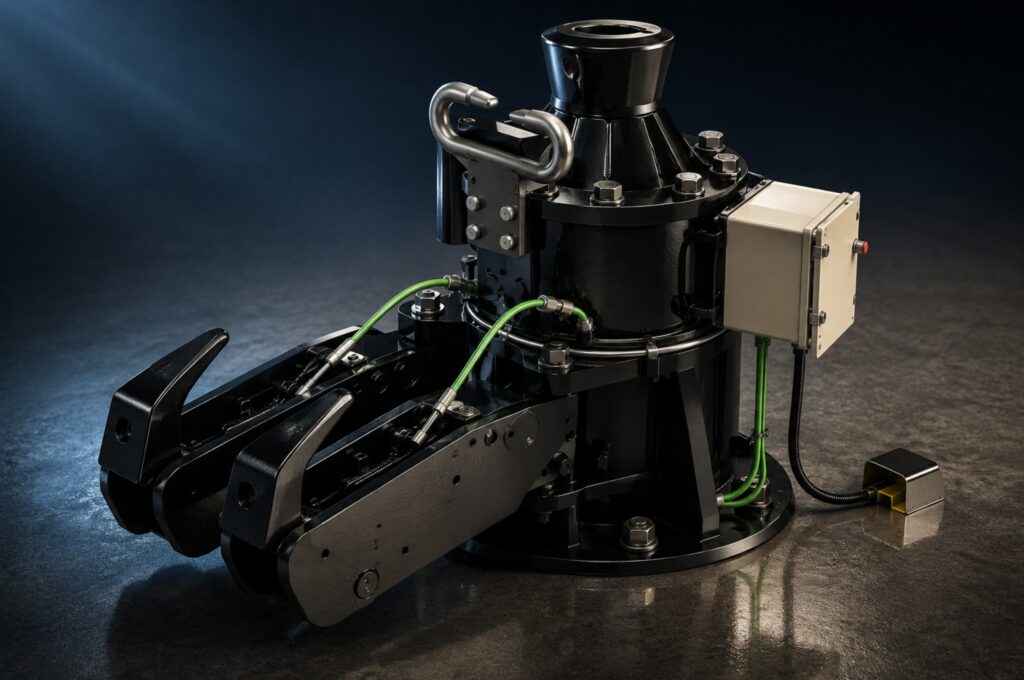
A Quick-Release Hook holds a mooring line under full working load during cargo operations, then drops it in a single controlled motion on command. On a Floating Storage Regasification Unit, where the same mooring arrangement simultaneously secures the vessel and enables safe LNG transfer, this combination of holding strength and instant release is not a convenience — it is a fundamental design requirement.

The Role of the QRH
Every mooring line on a vessel must eventually be let go — during departure, during an emergency, or when the vessel needs to shift. On most conventional ships this is done by hand: a crew member throws the eye of a rope off a bollard. Under low tension this is straightforward. Under the loads that accumulate during a prolonged LNG transfer in open or semi-sheltered water, it becomes physically impossible without prior slack in the line or mechanical assistance that simply is not available at the instant it is needed.
The Quick-Release Hook (QRH) resolves this problem by design. It is a spring-loaded or mechanically latched jaw device that grips the eye or bight of a mooring rope and holds it against the full working load of the line. When release is required, a lever or actuator trips the latch, the jaw swings open, and the rope falls clear — regardless of the tension it carries at that moment. The person operating the release handles no rope whatsoever.
On an FSRU conducting ship-to-ship (STS) LNG transfer, this capability directly underpins emergency disconnection procedures. Should a gas emergency, a mechanical failure on the transfer arms, or rapidly deteriorating weather require the attending LNG carrier to depart immediately, every mooring point must be released quickly and without manual struggle across the full deck. Only a system built around QRH units makes that possible at the scale of a large FSRU.

How a QRH Works
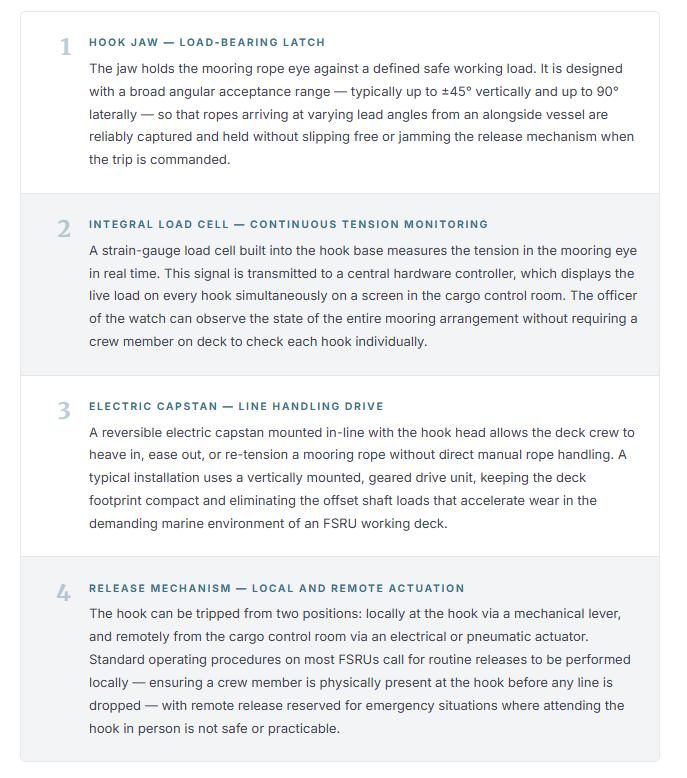
A modern FSRU QRH unit integrates four functional elements into a single deck-mounted assembly: the hook jaw, the load cell, the capstan, and the release mechanism. Each element serves a distinct purpose, but they are engineered to function as one coordinated system rather than as separate pieces of deck hardware bolted together.
Typical FSRU Arrangement
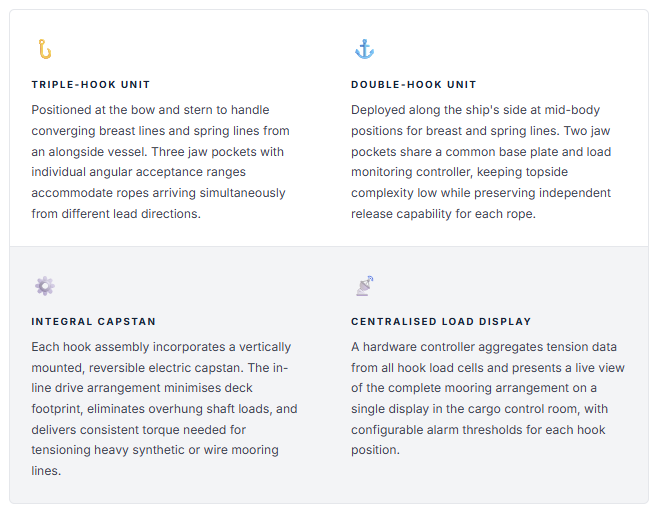
The number and configuration of QRH sets on an FSRU reflects the size of the vessel and the mooring pattern required for STS operations with large LNG carriers. A typical large FSRU installation combines triple-hook units at the extremities — where three converging mooring ropes must be handled at a single strong point — with double-hook units deployed along the parallel body of the vessel for breast lines and spring lines.
Triple-hook units present a wider jaw assembly that accepts three rope eyes simultaneously, each in its own jaw pocket. The angular limits of each pocket within the triple assembly are set to match the expected rope lead geometry from a large LNG carrier moored alongside. Double-hook units apply the same geometry to two ropes side by side. In both types, every jaw pocket is individually releasable, giving the deck officer the option to drop individual ropes selectively before committing to a full release.
Load Monitoring in Practice
The integration of real-time load monitoring transforms the QRH from a passive holding device into an active mooring management tool. During a multi-hour STS cargo transfer, mooring loads are not static. They shift continuously as gas transfers between vessels, as the LNG carrier’s trim and list change with cargo level, and as tide, swell, and wind conditions evolve across the operation. A hook carrying 40 tonnes at the start of a transfer may be carrying more than 100 tonnes six hours later if conditions have deteriorated and the mooring has not been actively managed.
With live tension data displayed centrally, the officer of the watch can respond to rising loads proactively — easing a heavily loaded line, taking in slack on another, or requesting the attending vessel to put out additional ropes before any individual hook approaches its operational limit. Active management of this kind reduces peak hook loads, extends the service life of both the equipment and the mooring ropes, and significantly raises the threshold at which an emergency release would become necessary.
Release Procedures & Safety
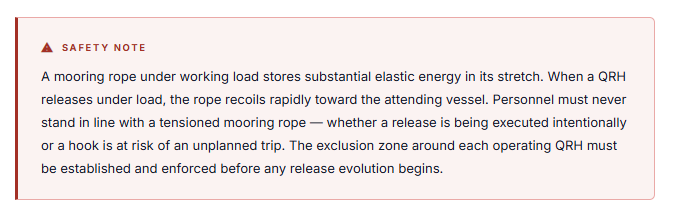
Emergency release of a QRH arrangement is a carefully sequenced evolution. Industry guidelines address both the sequence of events and the responsibilities involved. The general principle is that QRH release should be initiated only after the emergency disconnection sequence for the LNG transfer arms has been completed — or is running in parallel — to ensure the vessels do not separate while flexible loading arms or hoses remain connected between them.
Local release at each hook is the primary and preferred method. It requires a deck officer or rating to physically attend the hook, confirm it is safe to release, and actuate the trip lever. This physical presence provides a final human check: that no personnel are in the bight of the rope, that the transfer arm disconnect is progressing, and that the attending vessel is ready to receive slack. Remote release bypasses this check and is reserved for situations where attending the hook is genuinely not practicable — typically because the hazard driving the emergency makes the deck unsafe to enter.
Maintenance & Certification
QRH units are subject to a defined maintenance and certification regime under class society rules and industry guidelines. The key requirements fall into four categories:
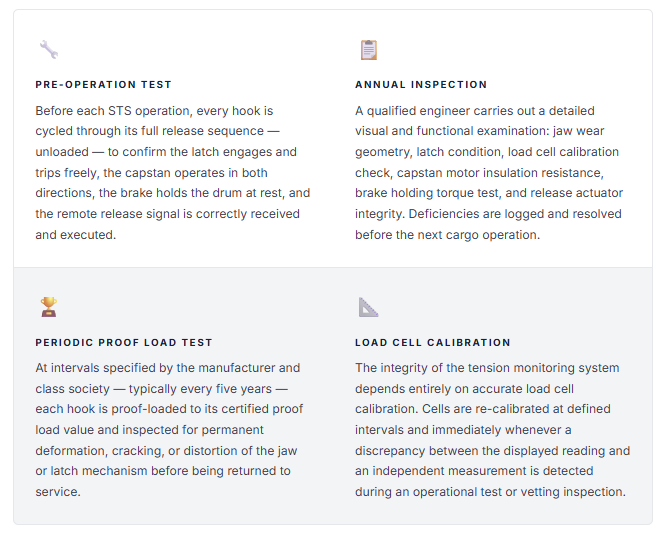
Certification of the complete QRH installation — including the structural deck connections, the electrical release circuits, and the monitoring display — is documented in the vessel’s mooring equipment register. This register must be made available to the terminal coordinator and the mooring master before any STS operation commences, confirming that all proof loads, calibrations, and inspection records are fully current.
Why It Matters on an FSRU
An FSRU operates simultaneously as a ship and as a terminal. As a ship, it must comply with flag state, class, and SOLAS requirements for mooring equipment. As a terminal, it must satisfy the additional safety case requirements of OCIMF, SIGTTO, and the operators of every LNG carrier it receives. The QRH system sits directly at the intersection of both roles — it is deck machinery within the ship’s safety management system, and simultaneously a terminal safety system whose certified readiness is a prerequisite for cargo operations approval.
Vetting inspectors routinely examine the QRH installation during pre-transfer assessments. They check proof load certificates, actuate the remote release circuit, verify that load monitoring displays are live and accurate, and confirm that the operations manual correctly documents the release sequence and emergency procedures. An FSRU that cannot demonstrate a fully certified, well-maintained QRH installation will not be approved to receive an LNG cargo — regardless of how capable its regasification systems may be.
For engineers and officers serving aboard an FSRU, the QRH therefore demands active engagement rather than passive familiarity. Understanding the mechanics, knowing the rated limits, verifying that each test has been completed and recorded, and being confident in executing a controlled or emergency release under pressure — these are not optional extras. They are the operational core on which every cargo transfer ultimately depends.
